

Bitcoin vs Monero: Which to Use on WTN
The short version, before the detail:
- Use Monero if your concern is someone following the money on a public blockchain back to you.
- Use Bitcoin if you already hold it and accept that the trail of the coins is public. Run it through a wallet you control, with a fresh address every time.
- Either way, the coin does not fix how you bought it. A purchase tied to your name is a link outside the blockchain.
WTN accepts both. The rest of this page shows how they differ where it matters: what each ledger reveals, what it costs, how long it takes, and which mistakes show up again and again.
Side by Side
| Point | Bitcoin (BTC) | Monero (XMR) |
|---|---|---|
| Ledger | Public. Anyone can follow transactions on a block explorer. | Public, but sender, receiver, and amount are hidden by default. |
| Sender | Visible as input addresses. | Hidden among decoys through ring signatures. |
| Receiver | Visible as an output address. | Hidden by one-time stealth addresses. |
| Amount | Visible. | Hidden. |
| Block time | About 10 minutes on average. | About 2 minutes on average. |
| Spendable after receipt | Technically at once. Wait for confirmations. | After a 10-block lock, roughly 20 minutes. |
| Fees | Rise and fall with network congestion and transaction size. | Based on transaction size and priority, not on the amount sent. Usually small. |
| Where to buy | Almost every exchange. | Fewer exchanges. Availability depends on where you live. |
| Extra privacy steps | Often needed, such as a wallet hop and fresh addresses. | Built in on-chain. The wallet hop still applies. |
What Bitcoin Gives Away
Bitcoin is pseudonymous, not anonymous. Addresses are not names, but every transaction ever made sits in a ledger that anyone can read. The Bitcoin paper itself describes privacy as a matter of keeping identities behind the keys, and notes that a new key pair for each transaction helps. See section 10 of the Bitcoin whitepaper.
In practice the trail leaks in two ways. First, when you spend coins from several addresses in one transaction, analysts assume the same person controls all of them and cluster them together. Second, the moment one address in a cluster touches an exchange that knows your identity, the whole cluster is attached to you. Companies sell this analysis to exchanges and investigators.
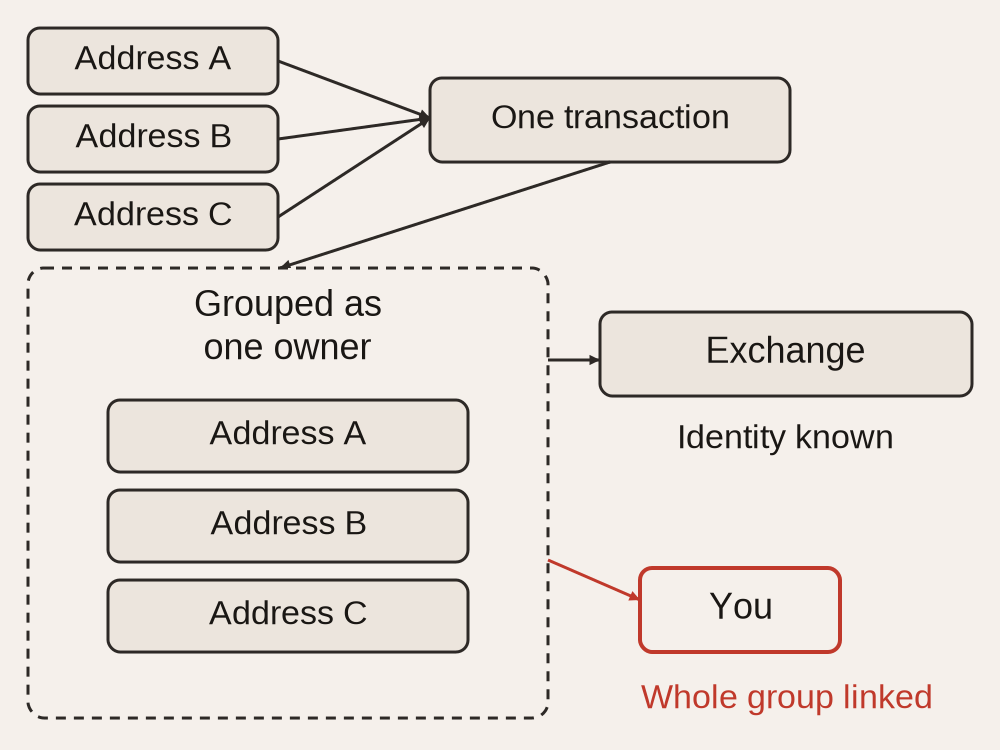
WTN generates a unique deposit address per transaction, as noted on the payments section of the homepage. That helps with address reuse on the market's side. It does not hide where your coins came from.
What Monero Hides, and What It Does Not
Three mechanisms do the work, and the Monero project explains each one:
- Ring signatures mix your real input among decoys, so an observer cannot tell which one was spent.
- Stealth addresses create a one-time address for every payment, so the receiver's real address never appears on-chain.
- RingCT hides the amount.
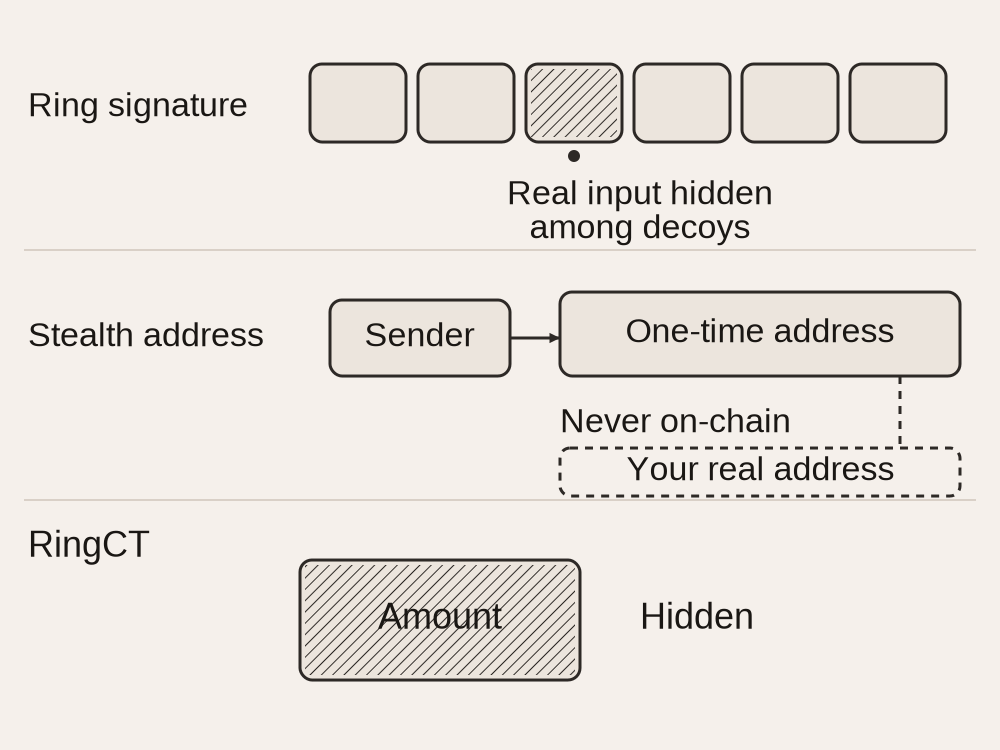
That removes the "follow the coins" step. It does not remove everything. Monero does not hide that you bought XMR on an exchange that holds your documents, and it does not hide your network location when you broadcast a transaction from a wallet that talks to a node over your normal connection. The wallet hop and an environment you control cover both. The Monero privacy guide walks through them.
A Note on CoinJoin and Mixing
People sometimes try to close Bitcoin's gap with CoinJoin, which combines inputs from several users into one transaction so the usual clustering assumption stops working. It can help, but it has limits. It does not hide that you used it, some exchanges treat mixed coins as a warning sign, and the tools and services in this space have changed. Some have shut down. Custodial "tumblers" add a different risk, since you hand your coins to a stranger.
If you reach for mixing, you are adding steps, fees, and trust to get a result Monero provides by default. That is worth knowing before you choose.
Fees and Confirmation Times
Bitcoin fees move with congestion. When the network is busy, a transaction that pays too little can sit for hours, and you pay more to get it through quickly. Monero's fee depends on how big the transaction is and the priority you pick, not on how much you send. It is usually small.
On timing, a Bitcoin block lands about every ten minutes, so a first confirmation takes about that long on average. Monero blocks arrive about every two minutes, but received funds are locked for 10 blocks, about 20 minutes, before the receiving wallet can spend them.
The guides and the homepage on this site say WTN credits a deposit after one to three confirmations. That is a statement about when the market updates your balance. The 10-block lock is a rule of the Monero protocol about when the funds can be spent. They are different things, so a deposit can show confirmations in your wallet and still be waiting on the market. Check the confirmation count before you contact anyone.
Mistakes That Repeat
Sending from an exchange straight to the market. The exchange knows who you are and sees the destination. Put a wallet you control in between, as the Monero guide describes. This applies to both coins.
Reusing a deposit address. Reuse links your payments together, on Bitcoin most of all. Take the fresh address WTN shows you each time.
Pasting the wrong address. Transactions cannot be reversed. A phishing page can swap the deposit address in the HTML, which is another reason to check the onion address first. See the PGP guide for verifying it.
Sending less after the rate moves. WTN shows the amount in both currencies at the time you order, so check it again if you waited before paying.
Rules about crypto, and about what you use it for, differ by country. Check yours. You are responsible for what you do with any of this.
Which One, in Three Situations
You care most about on-chain privacy
Choose Monero. It gives you hidden senders, receivers, and amounts without a mixing step. Buy it, move it to your own wallet, then send it. Plan for the extra wait because of the 10-block lock.
You already hold Bitcoin and move it rarely
Bitcoin works. Move it to a wallet you control, use a fresh address for each deposit, and do not send from an exchange in one hop. Accept that the trail is public.
Monero is hard to buy where you live
Swapping Bitcoin for Monero is possible, but it adds a service, a fee, and a trust decision. Compare the total cost with just using Bitcoin carefully. Do not use a swap site you cannot verify.
Bitcoin vs Monero FAQ
- Is Monero more private than Bitcoin?
- On-chain, yes. Monero hides the sender, the receiver, and the amount by default, while Bitcoin records all three on a public ledger. Neither coin hides how you acquired it, so an exchange purchase tied to your identity remains a link outside the blockchain.
- Can I use Bitcoin on We The North?
- Yes. WTN accepts both Bitcoin and Monero. Bitcoin is easier to buy, but the path of the coins can be followed on the public blockchain, so route funds through a wallet you control and use a fresh address for each deposit.
- Why is my Monero deposit still pending?
- Monero blocks arrive roughly every two minutes, and received funds stay locked for 10 blocks, about 20 minutes, before they can be spent. A deposit that shows pending for that long is not necessarily failed. Check the confirmation count in your wallet before you contact anyone.
What to Do Next
If you picked Monero, the Monero privacy guide covers the exchange, wallet, and market flow. Before you deposit, lock the account down with the account security checklist.
More: all guides · BTC and XMR on WTN · Tails · WTN forum